Skyline Research by The Options Engineer
Powered by the Options Engineering Framework & OS · Patent Pending

Explore Skyline

Research how engineered options structures behave across risk, payoff, and market conditions.

Skyline is a research series used to study payoff shape, Capital at Risk, market movement, and lifecycle behavior under defined assumptions.

The objective is to examine how payoff geometry, Capital at Risk, historical behavior, and lifecycle assumptions interact across a range of market outcomes. Skyline studies are presented as educational research and historical or illustrative analysis, not as recommendations or individualized investment guidance.

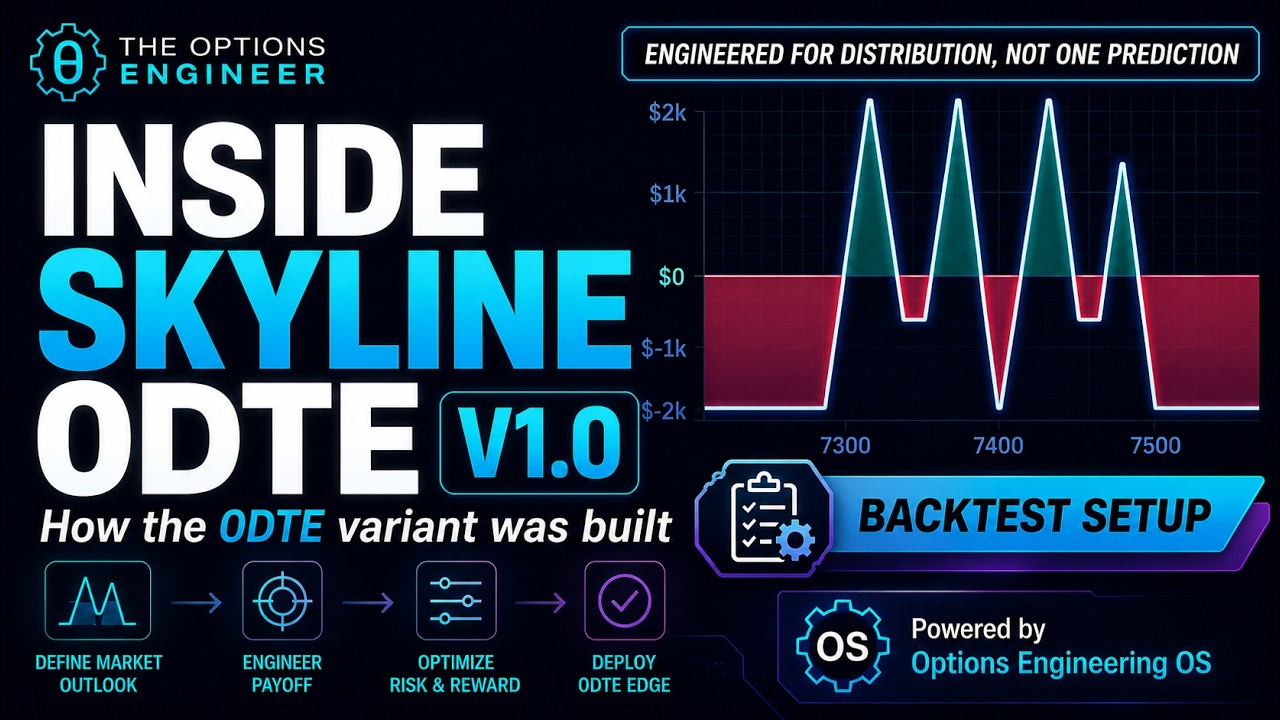
Skyline Butterfly 0DTE V1.0 research video
Skyline Butterfly 0DTE V1.0

Engineering process and backtest setup

A concise walkthrough of the payoff-design rationale, HTE research assumption, and saved backtest configurations used to document V1.0 as a reproducible research baseline.

HTE baselineThree saved tests400+ paired deployments
Educational research only. Historical results are hypothetical and unaudited, not actual account performance.
THE SKYLINE RESEARCH PROCESS
Define the research question
Follow the documented lifecycle
Review the evidence
Featured Skyline Research

Three studies. Three views of risk, structure, and capital efficiency.

Start with the published Skyline backtest, then compare its historical behavior with a 25-point iron condor and a longer-duration 14DTE study. Each study retains its own assumptions, test window, methodology, and limitations.

Study 01 · Public Backtest

Skyline Butterfly 0DTE V1.0 Backtest

The primary public reference for the original saved test, higher-cost sensitivity, and starting-capital sensitivity.

297.4%Original modeled CAGR from a $5,000 starting balance
-54.2%Original modeled maximum drawdown
265.4%Modeled CAGR under higher-cost sensitivity
189.8%Modeled CAGR in $10,000 starting-capital sensitivity

Hypothetical historical research. Results depend on assumptions and do not predict future performance.

Review the public backtest →
Study 02 · 0DTE Comparison

Skyline Butterfly 0DTE V1.0 vs. 25-Point Iron Condor

A matched SPX 0DTE study comparing two Skyline lots with one iron condor on an approximately CAR-aligned basis.

~244% higherModeled Skyline net P/L in the tested configuration
~18% lower CARModeled Skyline CAR in the tested 2-lot versus 1-lot comparison
76% vs. 68%Profitable months in the historical study
100% vs. 78%Profitable quarters in the historical study

Approximately CAR-aligned, not perfectly equal-CAR. Historical modeled comparison only.

Explore the 0DTE comparison →
Study 03 · 14DTE Comparison

Skyline Butterfly 14DTE V1.0 vs. 25-Point Iron Condor

A longer-duration comparison focused on modeled net P/L, time in market, and estimated portfolio-level CAR across overlapping positions.

49.6% moreModeled net P/L for Skyline in the tested configuration
4.1 fewerAverage days in each Skyline trade
19.7% lowerEstimated portfolio CAR across concurrent open positions
5.9 vs. 8.7Average concurrent positions: Skyline vs. iron condor

Historical modeled research; not actual account performance or a recommendation.

Explore the 14DTE study →
Options Engineering Framework · Patent Pending

Good research should explain the assumptions, risk regions, and market conditions being evaluated.

The Framework connects payoff shape, CAR, holding assumptions, market movement, adjustment criteria, and review so Skyline can be evaluated as a documented research process.

Payoff + CAR Research

Compare payoff behavior and modeled risk on a consistent capital basis.

Lifecycle Research

Document entry context, monitoring assumptions, HTE assumptions, adjustment criteria, and exits for analysis.

Decision-Process Research

Study whether clearer payoff zones and predefined risk boundaries reduce ambiguity as market conditions change. This is a research hypothesis, not a promise about investor behavior.

Options Engineering OS · Patent Pending

The analytical workflow behind the research.

The OS connects structure analysis, CAR analysis, monitoring, adjustment evaluation, replay, and review. It is presented here as a research and analytical workflow, not as a broker replacement, signal service, or source of personalized recommendations.

Design + Test

Build and compare structures, payoff zones, historical tests, and scenario assumptions.

Observe + Evaluate

Compare modeled assumptions with observed fills, timing, liquidity, and changing risk locations.

Replay + Review

Study outcomes against the original research thesis and document what changed.

Free Options Engineering Blueprint

Continue exploring the research.

Download the free Options Engineering Blueprint and receive Skyline research updates, methodology notes, and future research releases.